1
Introduction to The Nonviolent Radical: Seeing and Living the Wisdom of Jesus
So begins Jeannette Walls’ best-selling memoir, The Glass Castle. Her discovery of her mother in the dumpster shocks us, but less so after we learn of Walls’ childhood years of extreme poverty, an alcoholic and violent father, a negligent mother who did not protect Jeannette, her siblings or herself, and years of what most people would call “child abuse.” Yet Walls seems to have thrived as a child, graduated from college, and is now a successful writer.
What is truly shocking and almost unbelievable is how Walls could write a book all about her growing up in such a degrading environment without the slightest hint of judgment or blame of her parents or anyone else, only a lovingly kind book about a woman who followed the wisdom: Do not judge.
We all live our daily lives following the stated and assumed wisdom of the past. If we are Christians, we try to live by, teach, and preach the wisdom of Jesus each day and most deliberately on Sundays. For example, Jesus is quoted as saying: “Do not judge, so that you may not be judged. For with the judgment you make you will be judged, and the measure you give will be the measure you get. Why do you see the speck in your neighbor’s eye, but do not notice the log in your own eye?” (Matt 7:1–3; Luke 6:36–38).
We know from psychology that though judging and blaming others may be an entertaining habit, it is usually useless and often makes matters worse. On a personal level, psychological counseling succeeds only when the patient feels he or she is not being judged or blamed.
The same applies on interpersonal and social levels. Marriage counseling begins with the wisdom of Do Not Blame. And management-labor mediation and international diplomacy cannot work if one side insists on the other’s exclusive fault. Judging and blaming on all levels is counterproductive, and Jesus preached this already over two thousand years ago.
But we still don’t get it; judging and blaming are too much fun. Maybe a picture can communicate when words do not.
Judge Not
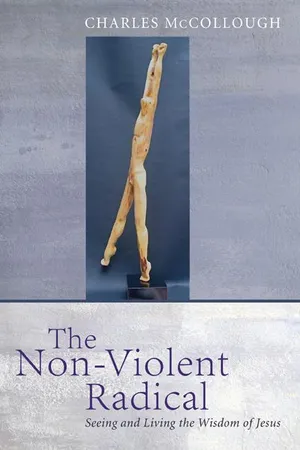
This image of a sculpture shows an aggressive man seeking to remove a speck from the eye of a hapless soul who, in turn, tries unsuccessfully to push away his blaming hand and to point out the beam in the blamer’s eye.
What This Book is About
This book seeks to do three things:
1. To show with images as well as to tell with words the meaning of wisdom sayings attributed to Jesus;
2. To interpret those wisdom sayings in the context of the economic and political world in which they were spoken; and
3. To provide practical ways to teach, preach, and live that wisdom today on both a private and a public level with both words and images.
I will assume the scholarly study of the gospels and the details of historical, form, textual, redactive, source, reader response, and postcolonial criticism, but I will keep that in the background. For I am aware that people today, and especially the young, obtain and maintain their wisdom in concise doses and with visual images. So you may use my images in this book for teaching, preaching, and daily living. My goal is to help us see with images the wisdom of Jesus.
I do not include the wisdom of Jesus’ parables in this book because they are available in my previous book, The Art of Parables, published by Wood Lake Publishing Inc., 2008. I learned from doing presentations on that parable book how eager people are to have images of biblical words and how eye-opening are the Bible’s economic and political perspectives. For although we tend to view the Bible almost exclusively from a private, personal level and ignore the economy and politics of the first century and our own, in fact the economy and politics cut deeply into our daily lives and attention to them illuminates the Bible’s often strange teachings. For example, when we read that Jesus was called the “Son of God,” it makes a big difference to know that Caesar was also called the “Son of God,” or that Herod was supposed to be the “King of the Jews” while his disciples called Jesus that same name. One scholar calls such naming of Jesus, “high treason.” Why is this clearly political matter of calling Jesus political names almost always avoided in favor of a spiritualized claim that Jesus was God, a name that a number of the Roman emperors also claimed for themselves?
To be sure, a recent rash of scholarly books has emphasized empire, peasant, subaltern, and political studies in the use and abuse of the Bible. But who in our pews or even our pulpits really reads these books or thinks from more than the radical, individualistic perspective of modern, western thought? I have read most of these books and delight in such visual resources as Living the Questions (LTQ), which I have used in my church. Virtually all of the scholars in that series include fine analysis of political/economic issues in Jesus’ life. Yet even so they are essentially talking heads. By contrast, in this book I seek to interpret Jesus’ wisdom sayings with original, visual art. My interpretation recognizes the interconnectedness of the economy, politics, and religion in the Bible for there was no separation of these areas in Biblical times. Unlike our modern separation of church and state, no such separation existed in biblical times.
Now a brief overview of wisdom in the Bible:
Wisdom is a very broad and even a cosmic and apocalyptic concept. It is the translation of Logos, and it is expressed in a literary form called a māšāl in the First Testament. The māšāl includes proverbs, parables, sayings, allegories, maxims, aphorisms, figures of speech, and similitudes. Most often in this book I will refer to proverbs. Alyce McKenzie helpfully defines a proverb as: “a short saying that expresses a complete thought, which, while most often expressing traditional values, is also capable of subverting them, offering ethical directives in certain new situations that are most often implied rather than directly stated.” Or, more simply, “a short sentence founded upon long experience, containing a truth.”
My approach is twofold: I will use visual art to express my interpretations of Jesus’ wisdom and I will interpret that wisdom in the political and economic context of his time. Jesus’ context was life in a colony of Rome in which 95 to 97 percent of the people were ruthlessly exploited in order to support the conspicuous consumption of the 3 to 5 percent elite in what scholars call an “aristocratic empire.” Jesus did not ignore the way this empire dominated 95 percent of the people with violence, fear, and state terror. Indeed, his central message and behavior proclaimed the opposite empire of nonviolence, courage, love, and the Empire of God that is in direct conflict with the Empire of Rome.
This economic and political approach goes against centuries of popular and scholarly study of the Bible, which has typically spiritualized, privatized, and individualized the text. Not only has the Bible been interpreted through these privatized eyes, the Bible itself also contains in some places justifications for imperial domination claiming it to be God’s will in spite of the teachings of the prophets and Jesus. But, as notes R.S. Sugirtharajah, postcolonial scholar and Professor of Biblical Hermeneutics at the University of Birmingham, there has been a “remarkable reluctance among biblical scholars to speak of imperialism in shaping the contours of biblical texts and their interpretation.”
Musa W. Dube of the University of Botswana spells out this approach of former colonial countries as follows: “Decolonizing de...